


The border crossing stamp helps make migration policy easier to control. When a foreigner crosses the border of most countries, the Border Service places a seal in their passport — the stamp. Its presence in the passport shows migration authorities that the foreigner has passed border control and is in the country legally.

Click to enlarge
You will learn:
- Why do you need a stamp in your passport when crossing the border?
- How to read the information on the stamp?
- Who to contact if the stamp was not placed?
Why Do You Get a Stamp at the Border?
You need the stamp for many procedures in Russia: for temporary registration, for getting a work permit. It is also checked when a foreigner contacts Russian authorities. For example, some work documents require the foreigner to have entered Russia no more than 1 week ago — that is why the stamp shows the date of the border crossing.
With automated passport control, the stamp may not be placed in your passport — this is not a violation. If you need the mark (for example, for your employer or for migration registration), go to the checkpoint: the border crossing data is stored in the electronic database of the Border Service. Foreigners are also given a migration card upon entry — it confirms the border crossing.
Sample of the Russian Border Crossing Stamp and the Main Data on It

Entry stamp to Russia, Domodedovo airport

ENTRY and EXIT stamps — how to tell them apart by the arrow

A collection of stamps, Pulkovo airport
Stamps can be blue or red — the color depends on the checkpoint and the period. Recently, most checkpoints (for example, in Pulkovo and Sochi) use blue.
At Russian checkpoints, delays caused by stamps in passports are common. People also come to our company for help after migration violations — for example, when a foreigner faces deportation from Russia. To help you avoid such trouble, we will show you what a correct border crossing stamp looks like.
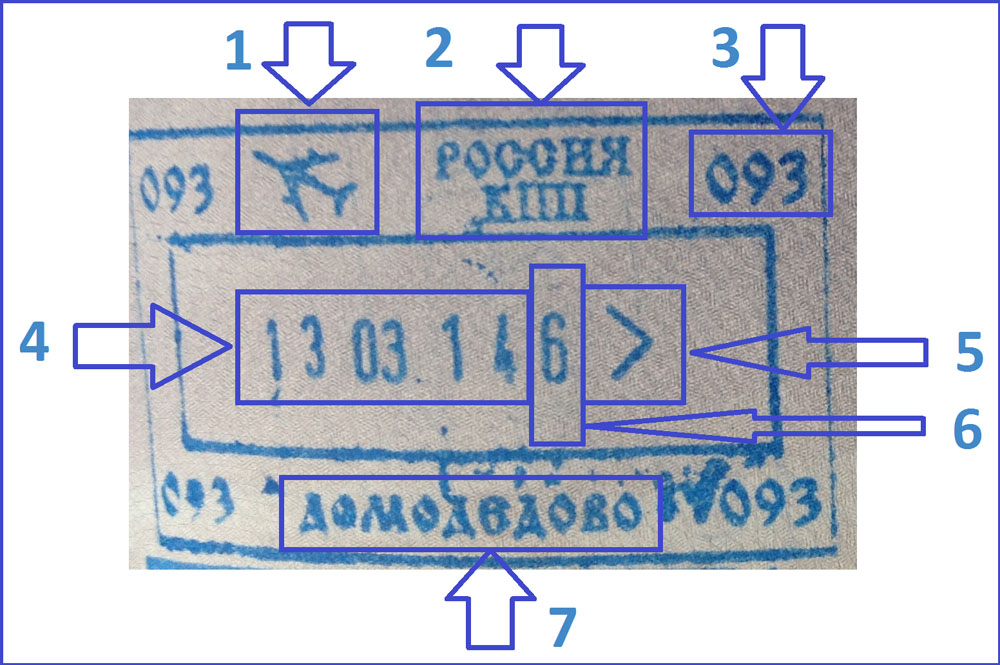
- Pictogram of the mode of crossing the border. (in the example — by plane; there are also pictograms for train and car.)
- Country and authority that placed the stamp (country: Russia; authority: border checkpoint.)
- Number of the stamping device — it is assigned to a specific officer of the Border Service.
- Day, month and year when the foreigner crossed the Russian border (in the example — March 13, 2014.)
- Entry/exit arrow. If the arrow points to the right of the date (as in the example) — it is an exit; if the arrow points at the date (to the left) — it is an entry into the country.
- Shift number of the officer who placed the stamp.
- Name of the border point where the foreigner crossed the border (in the example — Domodedovo.)
The data on the stamp helps reveal violations of the terms of stay of a foreign citizen in Russia and understand transit visa questions — the stamp shows where and when you entered the country and left it. In addition, based on the stamp in the passport placed on a previously obtained visa, Russian Consulates in different countries can decide whether to issue you a multiple-entry visa.
Click to enlarge
E-Visa and the Border Crossing Stamp
With a unified e-visa, the period of stay in Russia is 30 days from the moment of crossing the border. The entry stamp in your passport serves as the basis for tracking this period. Official information from the Russian MFA. You can apply for an e-visa here.
Who to Contact?
If you were not stamped when crossing the border or the mark came out unclear — contact the Border Service of the FSB of Russia at the checkpoint: the border crossing data is recorded in the electronic database, and the border guards can place the mark again. GoingRus.com does not place stamps — we are not a border authority. But we will help you with a visa, an invitation and migration registration. Contact us!
Full step-by-step instructions for getting a Russian visa